

How To Repair Joint Damage
Expansion Joint Vesture and Damage
An expansion joint is ordinarily located on structures such as bridges, highways and sidewalks. An expansion articulation is a mid-structure separation designed to absorb vibration, join objects, or permit motility. In structures, expansion joints can help blot the expansion and contraction of physical slabs every bit a result of temperature changes. Without expansion joints, the concrete tin can crack or distort. However, expansion joints on their own are susceptible to failure. A major event is incompressible materials that lock the joints and create stresses that may cause physical spalling or shattering. As a effect, seals are frequently installed in expansion joints to foreclose incompressible debris from inbound the joint. Ii types of common seals are strip seals and pinch seals.
Conventional Expansion Joint Seals
Strip seals are flexible neoprene membranes adhered to the joint walls. They attach well and prevent water ingress, but the seals tin tear and disjoin nether traffic if incompressible debris settles on pinnacle. Compression seals are neoprene or cellular seals in the grade of a series of webs that provide outward pressure level against joint walls to hold the seal in identify. They are fix for use out of manufacturing, meaning no mixing or curing is necessary. The seals demand to be correctly sized to maintain the force per unit area against the walls, but the seal tin can withal disjoin with the loss of elasticity over time.
Why are expansion joint repairs necessary?
Seals commonly fail due to adhesion loss and cohesion loss. Adhesion loss is evident when detachment of the seal from joint walls occurs. Adhesion loss is the loss of bond between the sealant and joint walls. Cohesion loss is evident when a tear on or in the seal occurs. Cohesion loss is the loss of internal bond in the sealant.
Expansion articulation repairs using the Belzona Solution
Conventional expansion joint seals have their own private disadvantages and common failures. Belzona provides polyurethane sealants that protect expansion joints from incompressible debris while offer advantageous mechanical backdrop including high movement capability, loftier elastic recovery, and high chafe resistance. In addition, Belzona polyurethane sealants comprise low odours and adhere well to a range of substrates.
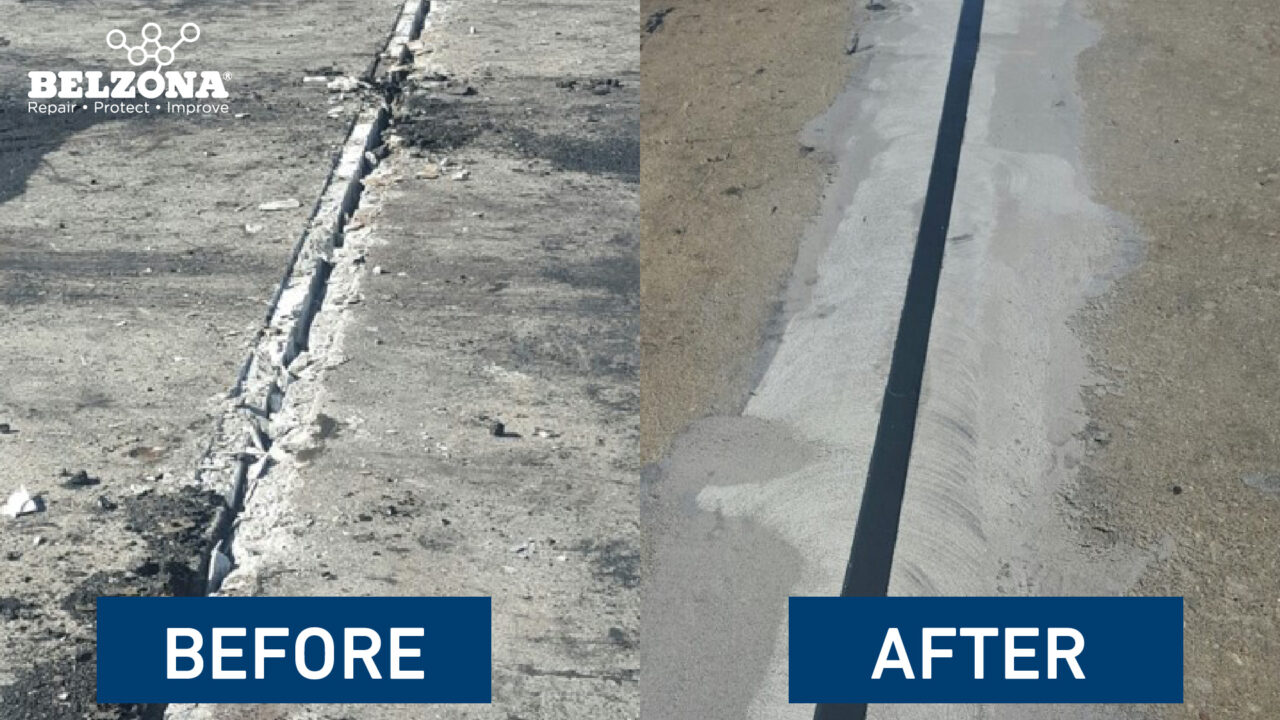
In our previous blog post "In Action: Repairing Failed Expansion Joints in Healthcare", we introduced an expansion joint repair method called "Smooth Ride", more often than not applicable to hospitals. In this blog post, we demonstrate an expansion joint repair that can apply to any industry and any type of concrete joint.
Video: How to Fix a Failing Expansion Joint with Belzona
For this repair, we used:
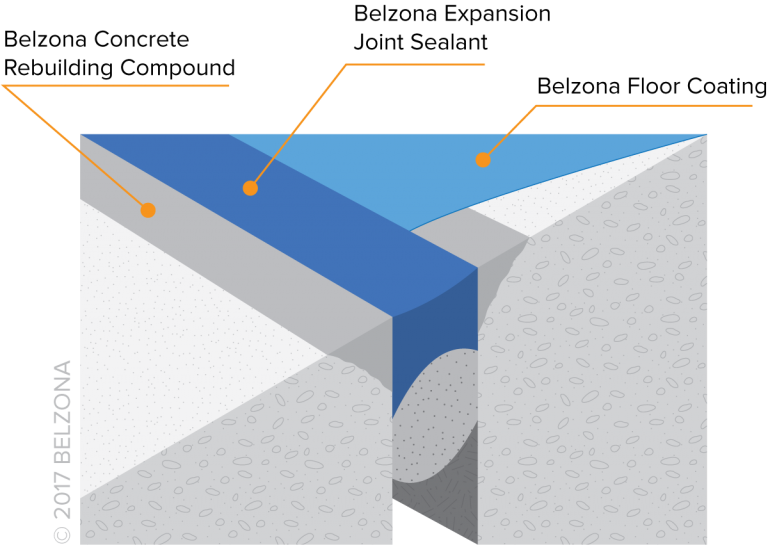
- Belzona 4111 (Magma-Quartz) and a wooden crossbar to reform the nosings of the joint
- Belzona 2221 (MP Fluid Elastomer) and a backer road to create a new joint sealant
- Belzona 5231 (SG Laminate) to provide protection of the expansion articulation and an aesthetic look
Additionally, we utilized Belzona 9111 (Cleaner/Degreaser) to clean the substrate, Belzona 9411 (Release Agent) to be applied to the wooden crossbar, a handheld grinder and a pole sander to fix the substrate, and a mixer for preparing Belzona 4111.
Stride-past-step instructions of expansion joint repair
- Remove all existing material
Using a grinder with a round disc, remove all existing fabric and vee out the edges of the nosings.

- Remove all debris
Vacuum all the debris and dust.

- Roughen the surface
Abrade the edges and the surface with a pole sander.

- Clean the surface
Thoroughly clean the surface with a cleaner/degreaser.

- Condition the Repair Surface
Thoroughly mix Belzona 4911 (Magma TX Conditioner) and brush it over the unabridged repair surface area.

- Insert wooden crossbar
Apply Belzona 9411 (Release Amanuensis) onto the wooden batten and position information technology in the articulation.

- Mix Belzona 4111
Thoroughly mix Belzona 4151 Base of operations and Solidifier until a homogeneous mix is achieved. Slowly add together Belzona 4111 Aggregate into the mix until the desired consistency is obtained.

- Trowel mixed Belzona 4111
Trowel mixed Belzona 4111 upwards to the former to rebuild the expansion joint nosings. Brand sure to fill in all the empty spaces with the mixed production.

- Press Down Firmly
Pack Belzona product downwards firmly to avert air pockets formation.

- Remove the batten
One time the Belzona production has cured, carefully remove the wooden former from the articulation.

- Insert backer rod
Insert pre-measured foam backer rod into the joint.

- Condition the Joint
Using Belzona 2911, condition the internal parts of the joint.

- Fill up the joint
Pour mixed Belzona 2221 to fill up the articulation.

- Smooth Out
Smooth out the surface, leaving information technology slightly concave.

- Mix Belzona 5231

Thoroughly mix Belzona 5231 Base of operations and Solidifier until a uniform colour is achieved.
- Use mixed Belzona 5231
Using a conventional pigment roller, apply mixed Belzona 5231 over the expansion articulation repair area.

- Application Consummate
Remove all record masking the joint and the repair expanse. The application is now complete!

Belzona's epoxy solutions tin can be used to repair failing expansion joints. Belzona also offer solutions to an extensive range of engineering problems and repair situations.
Interested in purchasing Belzona'south epoxy-based composites?


Source: https://blog.belzona.com/expansion-joint-repair/
Posted by: womacleorelp.blogspot.com
0 Response to "How To Repair Joint Damage"
Post a Comment